
I, Daniel
⏱️4 min read
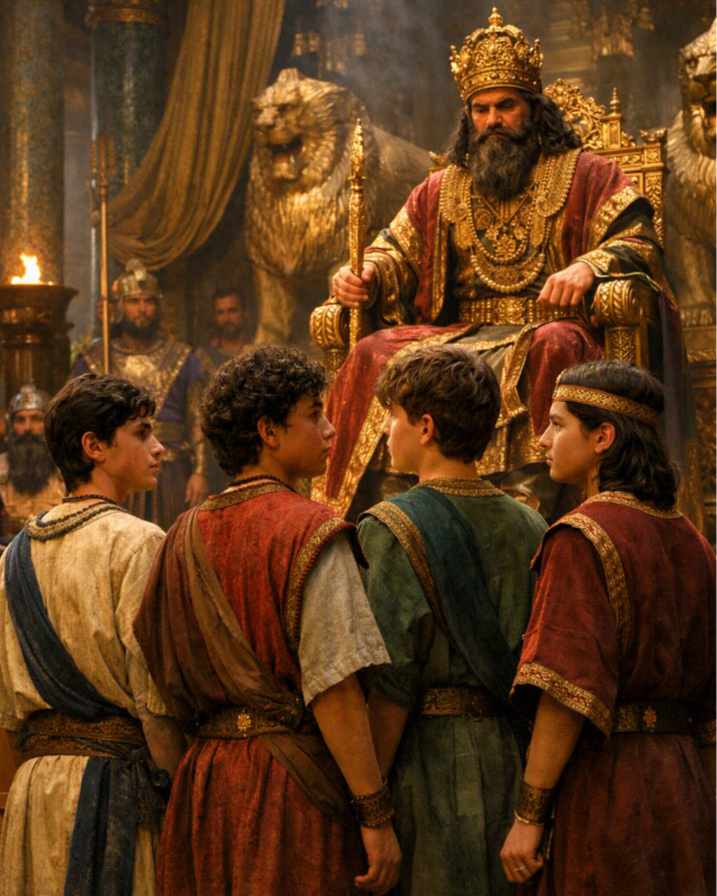
“Then the king instructed Ashpenaz, the master of his eunuchs, to bring some of the children of Israel and some of the king’s descendants and some of the nobles, young men in whom there was no blemish, but good-looking, gifted in all wisdom, possessing knowledge and quick to understand, who had ability to serve in the king’s palace, and whom they might teach the language and literature of the Chaldeans.” Daniel 1:3,4
Daniel 1 opens with a scene that feels ancient yet strangely familiar. Nebuchadnezzar commands his chief eunuch to gather the finest young men of Israel—those without blemish, gifted in wisdom, sharp in understanding, and capable of serving in the king’s palace. Among them were Daniel, Hananiah, Mishael, and Azariah.
But Scripture gives us a detail that reveals just how calculated this strategy was. The word used for “youths” in verse 4 is yeled—a term that typically refers to a younger, more impressionable boy, not the older adolescent implied by na’ar. In other words, Nebuchadnezzar was targeting the most vulnerable members of the covenant community.
He went after the generation still being formed.
Once in Babylon, the assimilation began immediately. These young covenant sons were given new names, new customs, new food, and three full years of Babylonian instruction. Every part of their environment was engineered to thoroughly reshape their identity.
Nebuchadnezzar understood something: If he could redefine the identity of the young, he could redirect the future of the nation.
And that is the same strategy the enemy still uses today.
Nebuchadnezzar’s conquest was strategic. He took the sons—the bene, those built to multiply, lead, and build. He took the nobility, the promising ones, the future of the nation. If he could wear down the strong, hope would collapse among the weak.
Then came assimilation:
New language
New literature
New diet
New environment
New names
Everything was crafted to make them forget who they were.
There are strong hints in Scripture (Dan.1:3; Is.39:7) that suggest they were even made eunuchs—stripped of the ability to reproduce. Isn’t that just like the enemy? Offer delicacies, comfort, and opportunity…only to steal destiny.
But Daniel Remembered
Daniel received a Babylonian name, but he never accepted a Babylonian identity. Over and over in the book that bears his name, he says, “I, Daniel.” Every time he spoke his name, he anchored himself in covenant: “God is my Judge.”
While culture tried to redefine him, covenant reminded him who he already was.
Your Identity Is Rooted in Covenant
You are not defined by the culture around you. You are not shaped by the pressures that try to rename you. You are not built by Babylon—you are built by God.
Just as Abraham “crossed over” into promise, you too are called to cross over—out of confusion, out of compromise, out of cultural captivity—into the identity God has spoken over you.
The enemy’s tactics haven’t changed:
Wear you down
Immerse you in culture
Steal your hope
Rename your identity
But Paul reminds us: “We are not ignorant of his devices.” And because we are not ignorant, we are not powerless.
A Charge for Today
When culture tries to rename you, respond like Daniel: “I, Daniel.” I know who I am. I know whose I am. I know the covenant I carry.
We are the ones marked by God to cross over from bondage into destiny. You are built—banah—to multiply. You are chosen to stand strong even in Babylon.
Walk in that identity today. Speak it. Live it. Protect it.
And let the world see a people who refuse to bow to the names Babylon gives.
Father, anchor our hearts in the identity You have given us, even in a culture overflowing with enticing options and shifting definitions. Grant us the courage of Daniel—a courage that stands firm, unmoved, and faithful in the midst of a reinvented Babylon. Amen.