Manna Moments
⏱️3.5 to 4 min read
The Blood That Passes Over: Covenant and Communion
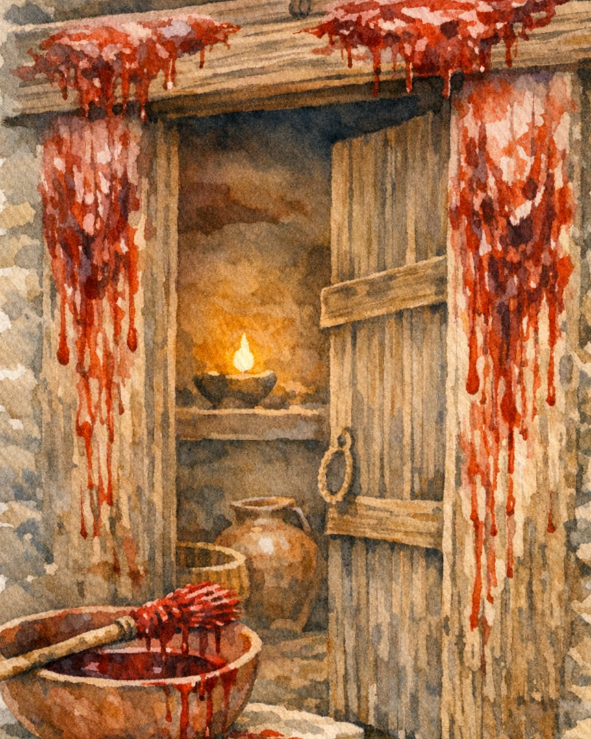
“On that night I will pass through the land of Egypt and strike down every firstborn male, both man and beast, and I will execute judgment against all the gods of Egypt. I am the LORD. The blood on the houses where you are staying will be a sign; when I see the blood, I will pass over you. No plague will fall on you to destroy you when I strike the land of Egypt.” Exodus 12:12,13
The night described in Exodus 12 was not a sudden act of divine judgment—it was the fulfillment of a promise God had spoken to Abraham exactly 430 years prior (Gal.3:17). In Genesis 15, when God cut covenant with Abram, He said:
“Know well that your seed shall be strangers in a land not theirs and they shall be enslaved and afflicted four hundred years. But upon the nation for whom they slave I will bring judgment, and afterward they shall come forth with great substance.”
Before speaking this, God instructed Abram to prepare a sacrifice and divide the pieces. Then, Scripture says, God passed through the midst of the sacrifice. That same divine movement—passing through—would later echo through Egypt as God passed through the land, striking the firstborn of those whose houses were not covered by the blood.
The covenant began in blood, and it was blood that marked the deliverance. The lamb’s blood on the doorposts wasn’t merely a ritual—it was a declaration of belonging. Every household that participated in the Passover had to be in covenant. Even the servants and foreigners dwelling among them had to be circumcised, the sign of covenant God had given to Abraham. Only then could they partake of the lamb.
Centuries later, Paul would echo this truth in his letter to the Corinthians:
“Whoever eats this bread or drinks this cup of the Lord in an unworthy manner will be guilty of the body and blood of the Lord… For he who eats and drinks in an unworthy manner eats and drinks judgment to himself, not discerning the Lord’s body.”1 Corinthians 11:27–29
Covenant still matters. It is the seal that sets us apart—the mark that tells the enemy whose we are. When God confronted Pharaoh, He revealed Himself in three ways: as YHWH, as the God of the Hebrews, and as the God of His battalions—the Commander-in-Chief, so to speak. Each name carried authority, each revealed His covenant power.
There are moments when we must take communion not out of routine but as a reminder—to ourselves and to the enemy—of Whose blood covers us. It is the Blood of the Lamb that sets us apart. David understood this covenant power when he faced Goliath. He wasn’t just a shepherd boy with a sling; he was a covenant son confronting a defiant enemy of the living God. When we stand in covenant, every threat against us is a direct challenge against Yehovah Sabaoth, the Lord of Hosts.
God kept His promise to Abraham and to Jacob, saying:
“I am God, the God of your father. Fear not to go down to Egypt, for a great nation I will make you there.” Genesis 46:3
When the firstborn males throughout all of Egypt were killed, God was simultaneously birthing His own firstborn—Israel (Ex.4:22). That night, the nation walked out of bondage not only free but whole and wealthy. Scripture says, “There was not one feeble among them” (Psalm 105:37). After four centuries of slavery, they left Egypt standing strong, carrying the substance of promise.
Maybe you’re standing at your own threshold —between what was and what’s next. The blood that marked the doorposts still speaks through the finished work of Christ. It declares covenant, protection, and belonging. You are covered. You are chosen. You are part of a promise that cannot be broken.
Lord, thank You for the Blood that covers me, cleanses me, and sets me apart. Remind me that covenant is not a ritual but a relationship. Teach me to partake of Your body and blood with reverence and gratitude, remembering that You are still the God who passes over, delivers, and brings Your people into promise. Amen.